01 / PHYSICALSystems that move.ROS2, hardware integration, and controlled motion.
02 / EVIDENCESystems that explain.Diagnostics, stale-state handling, and verifiable records.
03 / DELIVERYSystems that ship.Websites, client workflows, and practical software.
01ACTIVE
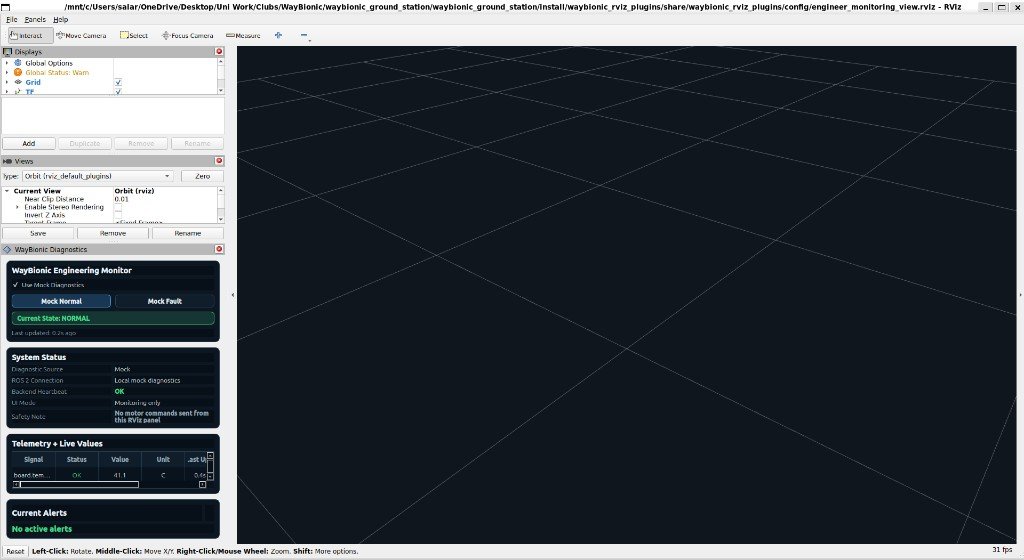
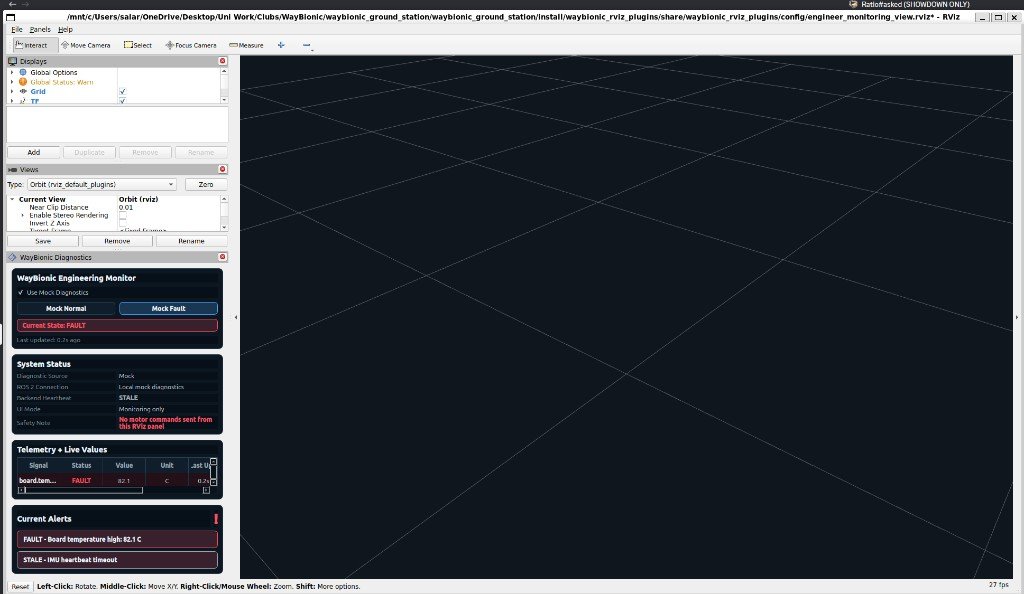
WayBionic — ROS2 Ground Station
A ground station for remote visibility and control of a surgical robotic arm, with motion tests publishing to a simulated joint-state driver.
MY CONTRIBUTIONBuilt the movement-test panels and diagnostics behavior that surfaces stale joint values and errors inside RViz; changed the arm wiring to match the control code.
ROS2 / C++ / PYTHON / RVIZ / SIMULATION
CONCEPTUAL / MOCK DIAGRAM● SIGNAL PATH
OPERATORRUN / HOME / STOP
→GROUND STATIONROS2 COMMAND
→JOINT DRIVERSIMULATED STATE
DIAGNOSTICSAGE / STALE / FUTURE
RVIZMONITOR + MODEL
This is a communication model, not a claim that every displayed path is the final production architecture.
OPEN CASE STUDY
- PROBLEM
- Give a remote operator real visibility and control over a surgical robotic arm without touching real hardware carelessly.
- SYSTEM
- ROS 2 Jazzy workspace with a five-joint RViz digital twin, controller teleoperation, joint-limit and collision checks, MKS CAN drives simulated by default, a doctor-view camera, and an RViz diagnostics panel with mock/live sources.
- KEY DECISION
- Keep simulation as the default; keep the diagnostics panel monitoring-only, and distinguish commanded or estimated motion from measured physical joint feedback.
- NEXT MILESTONE
- A bridge so the same ground station can drive a physical Arduino-controlled arm. Before that, validate actuator names, units, and position feedback against the approved robot model before presenting simulated or estimated state as measured hardware state.
02IN PROGRESS
Personal Robotics Roadmap
A sequence for building robotics skill in simulation first: imitation learning, reinforcement learning, then navigation and SLAM.
MY CONTRIBUTIONChose a simulation-first sequence to build robotics skill without purchasing hardware up front.
LEROBOT / MUJOCO / ISAAC LAB / NAV2
CONCEPTUAL / MOCK DIAGRAM● SIGNAL PATH
MUJOCOIMITATION
→ISAAC LABRL LOCOMOTION
→NAV2 / SLAMREAL NAVIGATION
This is a communication model, not a claim that every displayed path is the final production architecture.
OPEN CASE STUDY
- PROBLEM
- Build real robotics skill in sequence without needing to buy hardware up front.
- CURRENT DESIGN
- Start with Hugging Face LeRobot in MuJoCo simulation, then NVIDIA Isaac Lab for reinforcement-learning locomotion, then ROS2 Nav2 and SLAM.
- KEY DECISION
- Use the simulated MuJoCo environment instead of the physical LeRobot SO-101 kit to keep the project free while learning the same skills.
- NEXT MILESTONE
- SmolVLA fine-tuning as a stretch goal.
03IN PROGRESS
Rover Arm Motor Integration
A hardware-and-software integration study for connecting the Schulich Space Rover's robotic-arm motors to the rover computer.
MY CONTRIBUTIONResearched and wrote the team's 319-line integration document, then added the selected motors' constraints.
CAN / SOCKETCAN / C++ / DAMIAO MOTORS / LINUX
OPEN CASE STUDY
- PROBLEM
- The arm's Damiao motors speak CAN, the rover computer only has USB, and the team needed one dependable path between them before writing a driver.
- CURRENT DESIGN
- Rover computer USB to a USB-to-CAN adapter, then a single classic-CAN bus at 1 Mb/s to the shoulder (DM-J10422P), elbow (DM-J10010L), and wrist (DM-J4340P) motors, each with unique command and feedback IDs, 120-ohm termination at both ends, and motor power wired separately.
- KEY DECISION
- Run the whole mixed bus as classic CAN at 1 Mb/s even though the shoulder motor supports CAN-FD, and use Linux SocketCAN so the protocol stays independent of any one USB vendor.
- NEXT MILESTONE
- Bench-test one motor through SocketCAN and the OpenArm C++ library, then decide whether the team owns a small in-repository Damiao driver.
04SHIPPED
HVAC Express
A real web presence and technical infrastructure for a family-run Calgary heating and cooling company.
MY CONTRIBUTIONDesigned, built, and maintain the live site end-to-end, including token-based CSS architecture, Hostinger hosting, SEO work, and security remediation.
WORDPRESS / INFRASTRUCTURE
CONCEPTUAL / MOCK DIAGRAM● SIGNAL PATH
CALGARY CUSTOMERSEARCH / CONTACT / BOOKING
↓HVAC EXPRESS SITEWORDPRESS / PHP / HTML + CSS
↓HOSTINGERDOMAIN + INFRASTRUCTURE
LEAD SYSTEMSEO + INBOUND DEMAND
This is a communication model, not a claim that every displayed path is the final production architecture.
OPEN CASE STUDY
- PROBLEM
- A family-run Calgary HVAC company needed a real web presence and someone to own its technical infrastructure.
- SYSTEM
- The company site and infrastructure at calgaryhvacexpress.ca, built and maintained on WordPress.
- KEY DECISION
- Own the technical side while also doing direct sales, pairing build-it responsibility with customer conversations.
05SHIPPED
Autonomous Obstacle-Avoiding Rover
A wireless rover that detects and avoids obstacles with independent left and right motor control and sonar-based distance sensing.
MY CONTRIBUTIONProgrammed the control behavior and structured the Java class hierarchy around movement, sensing, acceleration, and challenge logic.
JAVA / PHIDGETS SDK / CS30 CAPSTONE
CONCEPTUAL / MOCK DIAGRAM● SIGNAL PATH
SONARDISTANCE INPUT
→CONTROL LOGICOBSTACLE DECISION
→LEFT DCMOTOR
RIGHT DCMOTOR
This is a communication model, not a claim that every displayed path is the final production architecture.
OPEN CASE STUDY
- PROBLEM
- Make a hardware system detect obstacles and respond without relying on a purely software abstraction.
- SYSTEM
- A Java program using the Phidgets SDK, independent motor control, sonar sensing, configurable acceleration modes, and closed-loop obstacle response.
- KEY DECISION
- Separate movement, sensing, acceleration, and challenge logic into a class hierarchy so the hardware-control problem remained testable and understandable.
- NEXT MILESTONE
- The resume records this as a completed capstone project.
06ACTIVE
Chinook Clean
A power-washing business Ajmal owns and runs, built around direct customer work, service delivery, and practical ownership.
MY CONTRIBUTIONOwns the business and handles the work from customer conversations through field execution.
ENTREPRENEURSHIP / FIELD OPERATIONS / CUSTOMER WORK
OPEN CASE STUDY
- PROBLEM
- Build and operate a service business where reliability, communication, and the finished result matter as much as the idea.
- SYSTEM
- A small field-operations business shaped by customer requests, scheduling, equipment, on-site work, and follow-through.
- KEY DECISION
- Keep the operation close to the customer and outcome rather than hiding behind a purely digital surface.
- NEXT MILESTONE
- Keep building repeatable service workflows and a stronger local operating system.
07ACTIVE
Physical AI BlackBox
A local-first evidence recorder for documenting what a physical AI system was told, commanded, and observed.
PYTHON / CBOR2 / CRYPTOGRAPHY / LOCAL SYSTEMS
OPEN CASE STUDY
- PROBLEM
- Physical AI needs an evidence trail that can be reviewed offline without trusting a remote service or hiding the raw record.
- SYSTEM
- A typed evidence core, canonical records, hash chaining, sealing and signature verification, a local owner portal, an investigator workbench, and a lightweight witness ledger.
- KEY DECISION
- Use established cryptography and deterministic CBOR libraries instead of implementing cryptographic primitives from scratch.
- NEXT MILESTONE
- Continue hardening the local owner, investigator, verifier, and release-packet workflows.
08IN PROGRESS
Teach to Game
A local reinforcement-learning lab with explicit game objectives, editable reward signals, and a Python PPO runner evaluated against a seeded random baseline.
MY CONTRIBUTIONShaped the target-aware Snake learning flow and live product dashboard; the portfolio also contains a separate in-browser tabular Q-learning teaching demo.
PYTHON / REINFORCEMENT LEARNING / PLAYWRIGHT / LOCAL LAB
OPEN CASE STUDY
- PROBLEM
- Training setups need an honest objective and reward signal instead of guessing what success means from a game screen.
- CURRENT DESIGN
- The repository uses Gymnasium and Stable-Baselines3 PPO for a numeric runner, logs episode reward and length to CSV, saves a checkpoint, and supports deterministic evaluation against a seeded random baseline. The browser demo is a separate 9x9 tabular Q-learning model that runs only in the current page.
- KEY DECISION
- Make objectives, rewards, and adapter controls explicit; keep training local and require user-provided game mappings so an agent cannot silently optimize the wrong signal.
- NEXT MILESTONE
- Retain and review reproducible training logs before publishing results or learning curves; keep third-party game adapters user-owned and outside online or anti-cheat games.
09IN PROGRESS
Soccer Intelligence Lab
A Next.js and TypeScript prototype that turns synthetic football events into match state, probability estimates, evidence-backed insights, and recaps.
MY CONTRIBUTIONBuilt the event-source pipeline, synthetic event processing, probability and insight layers, replay experience, and optional Azure Event Hubs adapter.
NEXT.JS / REACT / TYPESCRIPT / SYNTHETIC EVENTS
OPEN CASE STUDY
- PROBLEM
- Football data becomes useful when raw events can be connected to metrics, explanations, and experiences for different audiences.
- CURRENT DESIGN
- A provider-neutral event source feeds validated events into derived match state, a bounded Poisson outcome model, evidence-linked insights, and audience-specific recaps. Synthetic input works locally; Azure Event Hubs is an optional server-side source using DefaultAzureCredential.
- KEY DECISION
- Keep raw events, derived state, model outputs, explanations, and presentation payloads separate; label all current match data synthetic and treat probabilities as an uncalibrated prototype.
- NEXT MILESTONE
- Validate event handling and model calibration with licensed real match data before presenting probability outputs as predictive.
10PROTOTYPE
AIRCADE — Motion-Controlled Arcade
A five-game browser arcade exploring keyboard, local two-player, and experimental AirPods motion controls.
MY CONTRIBUTIONContributed the browser motion-input path, control mapping, and bowling integration in a collaborative hackathon build.
VITE / JAVASCRIPT / CANVAS / THREE.JS / SWIFT / COREMOTION / WEBSOCKET
OPEN CASE STUDY
- PROBLEM
- Revisit classic arcade play with more embodied controls while keeping the games playable from a keyboard.
- PROTOTYPE SCOPE
- Five browser game modules include Pong, Snake, Breakout, Bowling, and Tanks. A Swift CoreMotion sender, sample normalizer, and local WebSocket relay are present, but the team judging notes say live end-to-end motion play was not yet validated.
- KEY DECISION
- Keep keyboard play as the reliable fallback and label AirPods motion experimental until the sender, transport, and per-game mappings are tested together on hardware.
- NEXT MILESTONE
- Validate pairing, permissions, calibration, relay connectivity, and each claimed motion/game mapping; publish only combinations verified in a live run.
11PROTOTYPE
SouthPoint — Lunar Landing Site Navigator
A NASA Space Apps prototype for comparing lunar south-pole landing scenarios by modelled sunlight, Earth visibility, and slope.
MY CONTRIBUTIONContributor on the team repository, with 13 commits to the shared codebase.
REACT / VITE / TYPESCRIPT / FASTAPI / SKYFIELD / REACT THREE FIBER
OPEN CASE STUDY
- PROBLEM
- Landing-site trade-offs between sunlight, line of sight to Earth, and terrain are hard to see for mission teams and the public alike.
- PROTOTYPE SCOPE
- A React and TypeScript front end with a 2D map, sky dome, sun slider, 3D surface, and side-by-side compare, served by one FastAPI backend that computes Sun and Earth geometry with Skyfield and JPL DE421 and reads LOLA elevation data when installed.
- KEY DECISION
- Label every score, shadow, and window as exploratory screening rather than landing guidance, and fall back to clearly marked synthetic terrain when the elevation model is absent.
- NEXT MILESTONE
- Outputs remain a scenario-comparison prototype; nothing is validated for real mission planning.
12PROTOTYPE
Proofly — Community Work as Skill Evidence
A Hack the Change prototype that turns community work into signed, verifiable evidence of job-relevant skills.
MY CONTRIBUTIONLargest single contributor on a three-person team, with 32 of 52 commits.
NODE.JS / EXPRESS / SQLITE / WEB CRYPTO ED25519 / INDEXEDDB / AUTH0 / STRIPE IDENTITY / AWS BEDROCK / GROQ
OPEN CASE STUDY
- PROBLEM
- Volunteer and community work builds real skills, but employers have no trustworthy way to see them.
- PROTOTYPE SCOPE
- A Node and Express app with a student dashboard, example projects, a community vouch form, simulated coordinator review, Ed25519-signed credentials, and a separate employer lens.
- KEY DECISION
- Keep the demo fictional and account-free, keep secrets in host environment variables, and treat the identity and organisation verification flows as not production-ready.
- NEXT MILESTONE
- Harden identity verification and persistent credential storage before collecting any real personal information.
 MY WORK / FILE EXPLORER


 WAYBIONIC / ENGINEERING MONITOR
 BLACKBOX / PROJECT NOTES
 CHINOOK CLEAN / BUSINESS LOG
 TEACH TO GAME / RL LAB
 SOCCER INTELLIGENCE / EVENT LAB
 ROVER / CS30 CAPSTONE
 RESUME / AJMAL KHIDRI
 ABOUT AJ / PERSONAL
 SYSTEM INFO / AJMAL KHIDRI
 WORK HISTORY / TIMELINE
 SKILLS / TOOLBOX
 ROS2 / GRAPH VIEWER
 SYSTEM MONITOR
 OLD ARM / JOINT PANEL
 FILES / HOME AJ
 RESEARCH / PERSONAL
 BUILD NOTES / CURRENT
 TERMINAL / AJMALOS
 MEDIA PLAYER / WAYBIONIC
 SYSTEM RESTORE / AJMALOS
 RECYCLE BIN
 HVAC / COMFORT CALCULATOR
 CALCULATOR
 AJMAL BROWSER